Table of Contents
GEO vs SEO vs AEO: Understanding the Future of Search Visibility with Ads Bee Media
GEO vs SEO vs AEO: Do you have a great product or service, but still struggle to stand out in an overcrowded digital marketplace? Are you frustrated by the fact that even after investing in websites, content, and ads, your ideal customers still choose competitors they “recognize” and “trust” more than you? This isn’t just a traffic problem. It’s not even just an SEO problem. It’s a visibility, authority, and relevance problem in a world where search behavior has changed forever.
Ads Bee Media solves this challenge by aligning your brand with how modern search engines, AI tools, and answer platforms actually work today, not how they worked five or ten years ago. To do that effectively, you must understand the difference between GEO, SEO, and AEO, and why relying on only one is silently costing you growth every single day.
The Evolution of Search and Why Old Strategies Are No Longer Enough
For years, businesses believed that ranking on Google was the ultimate goal. If you could secure a few high positions for your target keywords, traffic would come automatically. In many cases, this was true. But search engines have evolved dramatically. Users no longer search the same way, and platforms no longer display results in the same format. Today, people expect instant answers, personalized recommendations, and local relevance. They ask questions verbally, they rely on AI summaries, and they trust brands that appear as authoritative voices rather than just websites with keywords.
Search engines have transformed into experience engines. They no longer simply list pages; they interpret intent, context, location, and credibility. As a result, three distinct but interconnected strategies have emerged: SEO, AEO, and GEO. Each serves a different purpose, and ignoring any one of them limits your digital presence.
Ads Bee Media approaches search visibility as a complete ecosystem, not a single tactic. To understand why this matters, it’s essential to explore each concept individually before comparing them directly.
What SEO Really Means Today and How It Has Changed
Search Engine Optimization, commonly known as SEO, was once about rankings alone. In its early days, SEO focused heavily on keyword placement, backlinks, and technical elements. While these factors still matter, SEO today is far more complex and user-focused than it used to be.
Modern SEO is about relevance, experience, and trust. Search engines evaluate whether your content genuinely answers user questions, whether your website loads quickly, whether users stay on your pages, and whether your brand demonstrates expertise and authority. SEO now blends technical performance with human psychology.
The Core Purpose of SEO in the Modern Digital Landscape
At its heart, SEO still focuses on helping your website appear in search engine results pages when users search for relevant topics. It ensures that your content is crawlable, indexable, and properly structured. It also ensures that your website communicates clearly to search engines what it is about and who it is for.
However, SEO alone no longer guarantees visibility. Even if your page ranks well, search engines might display featured snippets, AI-generated summaries, local packs, or zero-click answers that reduce actual website visits. This means that ranking does not always translate directly into traffic or conversions.
How User Intent Has Redefined SEO
User intent is now the foundation of effective SEO. Search engines categorize queries into informational, navigational, transactional, and commercial investigation intents. Content that does not match the underlying intent, no matter how optimized, struggles to perform.
Ads Bee Media focuses on intent-first SEO, ensuring that content not only ranks but also resonates with real users. This approach aligns traditional SEO with newer search models, creating a strong base for both AEO and GEO strategies.
AEO Explained: Optimizing for Answers, Not Just Rankings
Answer Engine Optimization, or AEO, represents a fundamental shift in how people interact with search platforms. Users increasingly ask questions instead of typing keywords. They use voice assistants, AI chatbots, and search features that display direct answers at the top of results.
AEO is about positioning your brand as the source of those answers.
Why Search Engines Are Becoming Answer Engines
Search engines aim to deliver the fastest, most accurate response possible. When someone asks a question, the platform tries to satisfy that query without requiring further clicks. This is why featured snippets, knowledge panels, and AI summaries have become so prominent.
In this environment, brands that structure their content clearly, provide precise explanations, and demonstrate authority are more likely to be chosen as answer sources. AEO focuses on clarity, context, and credibility rather than just keyword density.
How AEO Builds Instant Trust and Authority
When your content appears as the direct answer to a user’s question, it carries an inherent level of trust. Users associate that visibility with expertise, even if they never click through to your website. Over time, this establishes your brand as a reliable authority within your niche.
Ads Bee Media integrates AEO strategies into content creation by focusing on natural language, conversational tone, semantic relevance, and structured clarity. This ensures that content aligns with how AI systems interpret and deliver information.
GEO Defined: Why Geographic Relevance Is Now a Competitive Advantage
Generative Engine Optimization, commonly referred to as GEO, is one of the newest and most powerful concepts in digital marketing. GEO focuses on optimizing content for AI-driven generative platforms that personalize responses based on location, context, and user behavior.
While SEO targets rankings and AEO targets answers, GEO targets presence within AI-generated responses that adapt to individual users.
The Rise of AI-Driven Search and Generative Results
AI-powered platforms now generate original responses by pulling information from multiple trusted sources. These systems prioritize brands that demonstrate authority, consistency, and local or contextual relevance.
GEO ensures that when AI generates an answer, recommendation, or summary, your brand is part of that response. This goes beyond traditional ranking and moves into influence at the algorithmic level.
Why Location and Context Matter More Than Ever
Even global businesses need localized relevance. Users want answers that apply to their region, culture, and needs. AI systems factor in location, language, and behavioral patterns when generating responses.
Ads Bee Media implements GEO strategies by aligning content, brand signals, and contextual data so that AI platforms recognize your business as relevant within specific markets.
GEO vs SEO vs AEO: Understanding the Core Differences
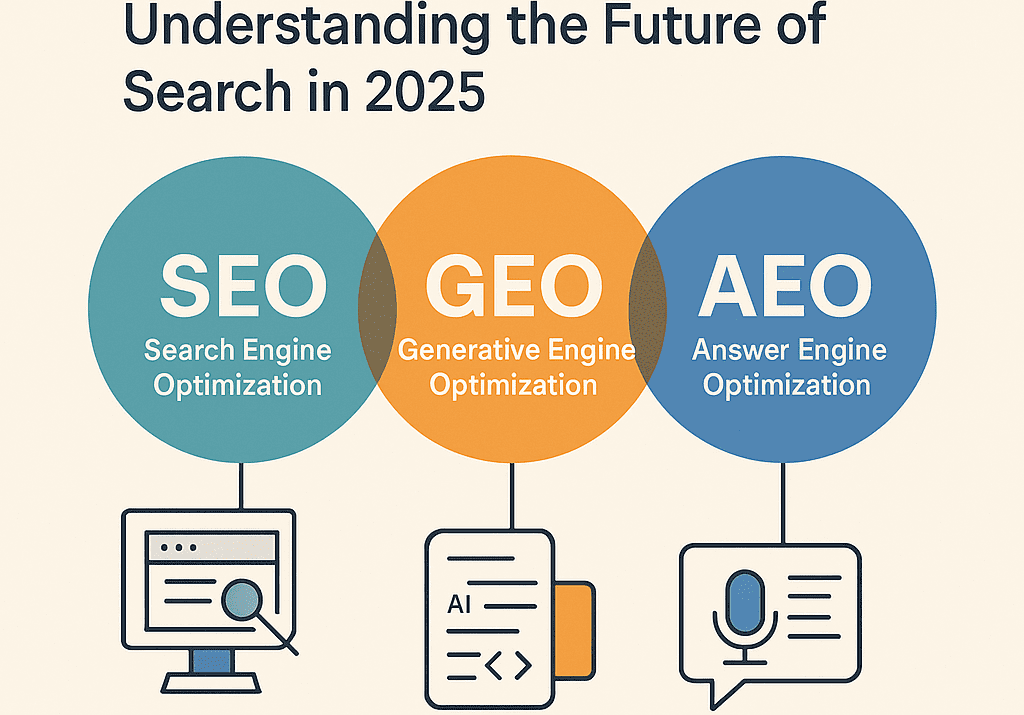
Although GEO, SEO, and AEO are interconnected, they serve different functions within a comprehensive digital strategy.
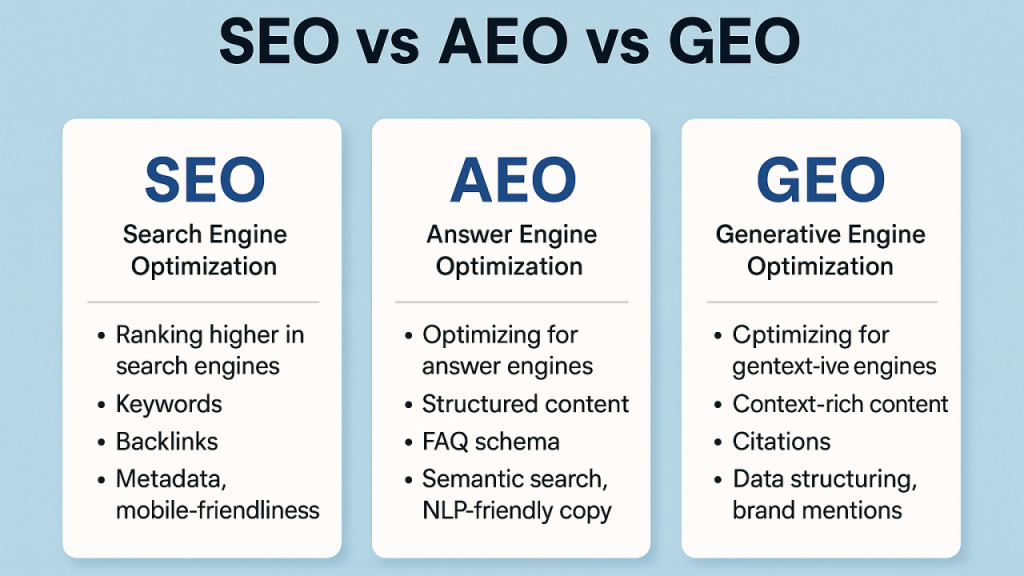
SEO focuses on visibility in traditional search listings by optimizing websites for search engines. AEO focuses on being selected as the direct answer within search features and AI tools. GEO focuses on influencing how generative AI systems include and describe your brand within personalized responses.
SEO drives discoverability. AEO builds authority. GEO amplifies influence.
How Each Strategy Serves a Different Stage of the User Journey
SEO often captures users in the research or comparison stage. They are exploring options and gathering information. AEO captures users seeking immediate answers or solutions. GEO reaches users at a deeper contextual level, often influencing perception even before they actively search.
Ads Bee Media treats these strategies as layers rather than replacements. Each layer strengthens the others, creating a durable digital presence.
Why Relying on Only One Strategy Limits Growth
Businesses that focus only on SEO risk becoming invisible in zero-click and AI-driven search environments. Those that focus only on AEO may miss sustained traffic opportunities. Those that ignore GEO may disappear from AI-generated recommendations entirely.
A balanced approach ensures resilience against algorithm changes and platform evolution.
How Ads Bee Media Integrates GEO, SEO, and AEO Seamlessly
What sets Ads Bee Media apart is its ability to unify these strategies under one cohesive framework. Instead of treating them as separate services, Ads Bee Media builds a single, adaptive system that evolves with search technology.
Content That Serves Humans First and Algorithms Second
Ads Bee Media believes that human-first content performs best across all optimization models. Content is written to educate, engage, and build trust while still aligning with technical and semantic requirements.
This approach naturally supports SEO by improving engagement metrics, supports AEO by delivering clear answers, and supports GEO by reinforcing authority signals used by AI systems.
Authority Building as the Foundation of All Three Models
Search engines and AI platforms prioritize expertise and trustworthiness. Ads Bee Media focuses on strengthening brand authority through consistent messaging, topical depth, and strategic content positioning.
Authority is what connects SEO rankings, AEO visibility, and GEO inclusion into a single growth engine.
The Business Impact of GEO, SEO, and AEO Working Together
When these strategies are aligned, businesses experience more than just traffic growth. They see improved brand recognition, higher-quality leads, and increased customer trust.
Users encounter your brand repeatedly across search results, answers, and AI-generated responses. This repetition builds familiarity, and familiarity builds confidence.
Ads Bee Media designs strategies that generate compounding visibility rather than short-term spikes.
Why the Future Belongs to Brands That Adapt Now
Search is not slowing down its evolution. AI integration will deepen, personalization will increase, and generative responses will become even more dominant. Businesses that cling only to outdated SEO tactics will struggle to stay visible.
GEO, SEO, and AEO are not trends. They are reflections of how users interact with information today.
Ads Bee Media positions brands ahead of this shift, ensuring they are not just found, but remembered and trusted.
Choosing Ads Bee Media for Future-Proof Search Growth
Understanding GEO vs SEO vs AEO is the first step. Implementing them effectively is where true expertise matters. Ads Bee Media combines technical knowledge with human insight, ensuring that your brand communicates clearly to both people and algorithms.
In a world where attention is scarce and trust is everything, being visible is not enough. You must be credible, contextual, and compelling wherever your audience searches.
That is not just optimization. That is strategic digital growth led by Ads Bee Media.
Contact us:
Give Us A Call
+977-982 392 2225
Office Location
Railway Road, Birgunj Nepal
Send Us A Message
[email protected]
Site:-
Frequently Asked Questions on GEO vs SEO vs AEO – Ads Bee Media
1. What is the main difference between SEO, AEO, and GEO?
SEO focuses on ranking websites in traditional search engine results. AEO focuses on providing direct answers that appear in featured snippets, voice search, and AI answers. GEO focuses on optimizing brand presence within generative AI responses that consider context, personalization, and location.
2. Is SEO still relevant in the age of AI search?
Yes, SEO is still relevant, but it is no longer enough on its own. It now works best as the foundation that supports AEO and GEO strategies rather than being the sole focus.
3. What does AEO stand for and why is it important?
AEO stands for Answer Engine Optimization. It is important because users increasingly want quick, direct answers rather than lists of links, especially on voice search and AI-powered platforms.
4. What does GEO mean in digital marketing?
GEO refers to Generative Engine Optimization. It focuses on ensuring your brand appears accurately and positively in AI-generated responses and summaries based on user context and location.
5. How does Ads Bee Media approach SEO differently?
Ads Bee Media focuses on intent-driven, human-first SEO that aligns technical performance with meaningful, trustworthy content designed for modern search behavior.
6. Can SEO, AEO, and GEO be used together?
Yes, they are most effective when used together. SEO builds discoverability, AEO builds authority, and GEO ensures influence within AI-generated results.
7. What role does content play in AEO?
Content is central to AEO. It must be clearly structured, conversational, accurate, and focused on answering specific user questions directly.
8. Why is GEO considered future-proof?
GEO aligns with how AI-powered systems generate responses, making it relevant as search continues shifting toward personalized and contextual answers.
9. Does GEO replace SEO?
No, GEO does not replace SEO. GEO builds on SEO signals such as authority and relevance but applies them within generative AI environments.
10. How does user intent affect SEO today?
User intent determines how search engines rank and display content. Content that matches intent performs better than content that only targets keywords.
11. What type of businesses need AEO?
Any business that wants visibility in voice search, featured snippets, AI summaries, and instant answers benefits from AEO.
12. How does Ads Bee Media ensure content ranks and converts?
Ads Bee Media combines strategic keyword research, intent mapping, authoritative writing, and user-focused messaging to balance rankings with conversions.
13. Is GEO only useful for local businesses?
No, GEO benefits both local and global businesses by helping AI systems understand contextual relevance across different regions and audiences.
14. Why are zero-click searches increasing?
Zero-click searches increase because search engines aim to give users immediate answers without requiring them to visit a website.
15. How does AEO help with zero-click searches?
AEO ensures your brand is still visible and trusted even when users don’t click, by positioning your content as the answer source.
16. What platforms are influenced by GEO strategies?
GEO impacts AI-driven search engines, chat-based assistants, and generative recommendation systems.
17. How does authority affect GEO performance?
High authority increases the likelihood of your brand being referenced or summarized by AI-generated responses.
18. What makes Ads Bee Media different from traditional agencies?
Ads Bee Media integrates SEO, AEO, and GEO into a single adaptive strategy instead of offering fragmented services.
19. Can small businesses benefit from GEO?
Yes, GEO levels the playing field by prioritizing relevance and authority over brand size alone.
20. Is keyword research still necessary for SEO?
Yes, but it must be intent-focused and contextual rather than purely volume-driven.
21. How does voice search relate to AEO?
Voice search relies heavily on AEO because users ask full questions and expect conversational answers.
22. What role does trust play in modern search?
Trust is critical. Search engines and AI platforms prioritize sources that demonstrate expertise, credibility, and consistency.
23. How does GEO affect brand perception?
GEO shapes how AI platforms describe and recommend your brand, influencing perception even before users engage directly.
24. What kind of content works best for AEO?
Clear explanatory content, how-to guides, definitions, and problem-solving content perform best for AEO.
25. Does Ads Bee Media focus on long-term or short-term results?
Ads Bee Media prioritizes sustainable, long-term growth rather than short-lived ranking wins.
26. Why is human tone important in SEO content?
Human tone improves engagement, readability, and trust, all of which influence search performance.
27. How does semantic relevance support SEO and AEO?
Semantic relevance helps search engines understand context and relationships between topics, improving visibility across multiple formats.
28. What is the biggest mistake businesses make with SEO today?
Relying solely on outdated keyword-based tactics without considering intent, experience, and AI-driven results.
29. How does GEO respond to changes in AI algorithms?
GEO focuses on principles like authority and relevance, which remain stable despite algorithm changes.
30. Can AEO increase brand credibility?
Yes, appearing as a direct answer positions your brand as knowledgeable and trustworthy.
31. How does Ads Bee Media handle content strategy?
Content strategy is built around audience needs, search behavior, and future-proof visibility models.
32. Is technical SEO still important?
Yes, technical SEO supports site performance and accessibility, which affect all optimization models.
33. How does context influence GEO results?
AI platforms evaluate context such as location, intent, and behavior to generate personalized responses.
34. Can GEO help with international markets?
Yes, GEO ensures your brand appears relevant across different regions and languages within AI-generated outputs.
35. Why is consistency important in SEO and GEO?
Consistency strengthens brand signals and helps AI systems trust and recognize your content.
36. How does Ads Bee Media measure success?
Success is measured through visibility, authority growth, engagement quality, and conversion performance.
37. What industries benefit most from AEO?
Service-based, educational, and solution-driven industries benefit greatly from AEO.
38. Is it possible to optimize old content for AEO and GEO?
Yes, existing content can be updated for clarity, structure, and relevance to perform better.
39. How does GEO handle personalization?
GEO aligns content signals so AI platforms can personalize results accurately for different users.
40. Why are AI summaries changing SEO strategy?
AI summaries reduce clicks but increase the importance of brand mention and authority.
41. What is intent mapping and why does it matter?
Intent mapping aligns content with user needs at different stages, improving relevance and performance.
42. How does Ads Bee Media future-proof SEO strategies?
By integrating SEO with AEO and GEO, Ads Bee Media prepares brands for ongoing search evolution.
43. Does GEO require constant updating?
GEO benefits from consistent content refinement to maintain relevance and authority.
44. How does AEO impact customer decision-making?
Being the direct answer influences trust early in the decision-making process.
45. Can SEO still generate organic traffic effectively?
Yes, especially when combined with intent-focused content and strong user experience.
46. Why do AI engines prefer authoritative brands?
Authoritative brands reduce the risk of misinformation, aligning with platform goals.
47. How does Ads Bee Media align branding with search visibility?
Brand voice, expertise, and messaging are integrated into all content strategies.
48. What is topical authority and why is it important?
Topical authority signals deep expertise, improving visibility across SEO, AEO, and GEO.
49. Can GEO influence recommendations, not just answers?
Yes, GEO can influence AI-driven recommendations and summaries.
50. How does user behavior affect SEO rankings?
Engagement signals like time on page and bounce rate influence ranking performance.
51. Is AEO limited to Google?
No, AEO applies to multiple platforms including voice assistants and AI chat systems.
52. What makes content AI-friendly?
Clear structure, accurate information, logical flow, and trusted sources.
53. How often should SEO strategies be reviewed?
SEO strategies should be continuously monitored and refined.
54. Why is E-E-A-T important for AEO and GEO?
Experience, expertise, authority, and trustworthiness guide AI content selection.
55. Does Ads Bee Media focus on niche or broad targeting?
Both, depending on business goals and audience behavior.
56. How does GEO support brand storytelling?
It ensures AI platforms present your brand narrative accurately and consistently.
57. Can AEO reduce dependency on paid ads?
Yes, strong organic answers reduce reliance on paid visibility.
58. How does SEO support content discoverability?
SEO ensures content is indexed, ranked, and accessible.
59. What happens if businesses ignore GEO?
They risk disappearing from AI-generated conversations and recommendations.
60. How does Ads Bee Media handle algorithm changes?
By focusing on enduring principles like relevance and authority.
61. Is long-form content still valuable for SEO?
Yes, when structured properly and aligned with user intent.
62. How does AEO relate to conversational search?
AEO is essential for conversational and natural language queries.
63. Can GEO benefit ecommerce brands?
Yes, especially for product recommendations and comparisons.
64. How does Ads Bee Media balance optimization and creativity?
By writing for humans while aligning with algorithmic requirements.
65. What role does clarity play in AEO?
Clarity increases the chance of being selected as an answer.
66. Can GEO increase brand recall?
Yes, repeated AI mentions strengthen brand memory.
67. Why is future-ready optimization important?
Search behavior changes rapidly, and adaptability ensures continuity.
68. How does Ads Bee Media ensure ethical SEO practices?
By following best practices focused on value, accuracy, and transparency.
69. What is the biggest advantage of combining GEO, SEO, and AEO?
It creates compounding visibility across all modern search touchpoints.
70. Why should businesses trust Ads Bee Media for search growth?
Because Ads Bee Media understands not just how search works today, but where it is headed tomorrow.
Contact us:
Give Us A Call
+977-982 392 2225
Office Location
Railway Road, Birgunj Nepal
Send Us A Message
[email protected]
Site:-